Buying an electric tourist train requires more than choosing an attractive locomotive style. Passenger capacity, route conditions, battery configuration, charging arrangements and the intended operating purpose all influence which train is appropriate.
DINIS currently presents multiple electric trackless train capacities and specifically notes that larger configurations can be used when the operator needs to transport more passengers between points.
An electric trackless tourist train buying checklist should therefore start with the operation itself rather than the appearance of the vehicle.
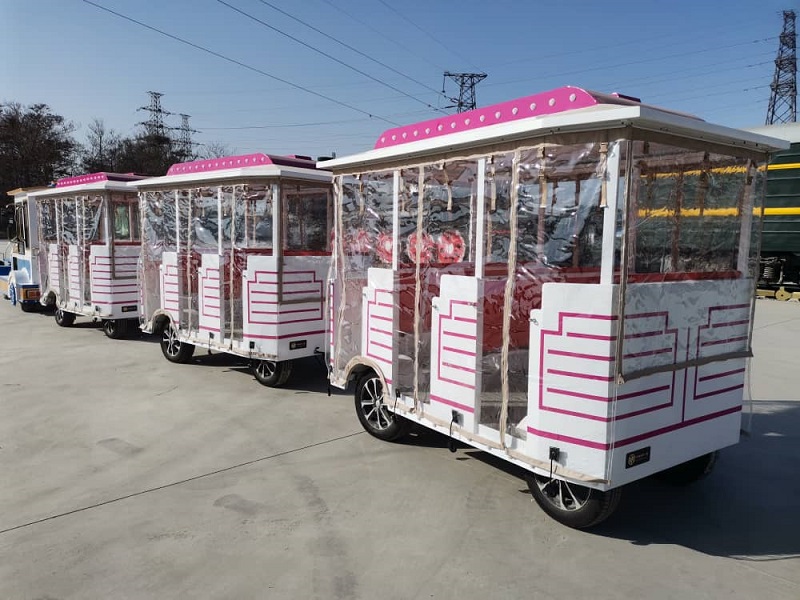
What Will the Train Actually Be Used For?
First decide whether the train is primarily an attraction, a sightseeing service or an internal transport vehicle.
A shopping center may operate short recreational circuits. A resort may use the train to connect accommodation and entertainment areas. A scenic destination may require longer routes and more passenger movement.
These applications create different requirements for capacity and departure frequency.
An operator running a short entertainment loop may value frequent departures and compact dimensions, while a large destination moving organized groups may prioritize greater passenger capacity.
Defining the purpose prevents the buyer from selecting a configuration that is either unnecessarily large or too small for peak demand.
How Many Passengers Need to Travel on Each Departure?
Seat capacity should be based on expected demand during busy periods.
Do not calculate only the total number of visitors in the venue. Estimate how many are likely to use the train within one hour and how many departures can realistically be completed.
The related trackless train model and power comparison is useful because trackless trains can vary not only in passenger capacity but also in power arrangement and intended application. The DINIS trackless-train page also discusses the choice between electric and diesel configurations.
Capacity and frequency should therefore be planned together.
What Should You Ask About the Battery and Charging System?
Battery information needs to be evaluated in the context of the actual route.
A buyer should confirm the battery type and configuration supplied with the selected train, expected charging requirements and the operating conditions used when any runtime estimate is provided.
Route length, passenger load, gradient, repeated acceleration and climate can all affect real operating conditions, so a quoted operating time should not be treated as an unconditional guarantee.
A modern battery management system is designed to monitor and manage rechargeable battery packs, which illustrates why battery operation involves more than simply comparing nominal battery capacity.
The charging area and daily operating schedule should be planned before the train arrives.
Have You Checked the Entire Route?
A train that fits the budget may still be unsuitable for the site.
A battery sightseeing train procurement evaluation should include total route length, narrowest turn, gradients, road width, road surface and the positions of boarding and unloading areas.
The route should be measured rather than estimated visually.
Operators also need to consider interaction with pedestrians. In busy parks and resorts, the train route should be easy for visitors to understand and should avoid unnecessary conflict with major pedestrian flows.
If the train will enter a public-road environment, applicable local vehicle and passenger-transport requirements should be confirmed separately.
What Maintenance and Spare-Part Questions Should You Ask?
Before purchase, buyers should understand which components require routine inspection and what maintenance information will be provided.
Ask about tires, braking components, steering, electrical systems, batteries, passenger-carriage connections and other parts relevant to the selected train.
It is also useful to clarify which consumable or wear components should be kept locally. For overseas projects, having a reasonable spare-parts plan can reduce the disruption created by waiting for individual components after the train has entered operation.
Do not evaluate after-sales support only by the length of a warranty statement. The availability of documentation, technical communication and replacement parts is also important.
What Information Should You Give the Supplier Before Ordering?
Prepare the venue type, route map, route length, narrowest turn, maximum gradient, expected passenger volume, operating hours and available charging period.
The DINIS tourist train selection team can use this information when discussing suitable capacity and configuration.
The final model should be selected only after passenger demand, route conditions and power requirements have been considered together. This gives the supplier a much clearer basis for recommending equipment than a request such as “send me your largest electric train.”
Detailed electric trackless train information is available at https://www.dinistrains.com/electric-trackless-train/