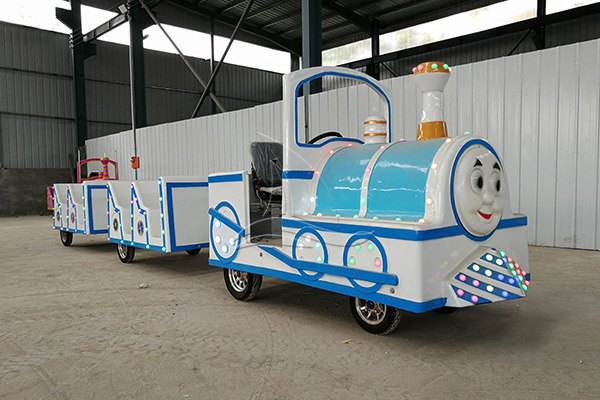
Battery capacity decides whether a mall train completes a full trading day without stopping for a recharge, or whether it spends the afternoon parked at a wall socket. Sizing the battery correctly also avoids paying for energy storage the train will never use. This guide explains how to calculate a practical mall train battery capacity for all-day operation.
Start with the Daily Energy Demand
Energy consumption depends on three variables: route length, number of trips, and passenger load. Multiply the route distance by the number of daily circuits to find the total distance travelled, then consider how full the train runs. A train carrying 40 passengers uses noticeably more energy than the same train with 10, especially when accelerating after each stop. Mall routes usually involve frequent starts and stops, which is harder on the battery than steady running.
Battery Chemistry: Lithium or Gel
Lithium batteries offer longer life, faster charging, and more usable capacity for the same weight, which makes them the preferred choice for a battery powered mall train that operates eight to twelve hours per day. Gel batteries cost less initially but discharge more slowly, weigh more, and need longer charging periods. For malls that operate seven days a week, the lithium option usually wins on total cost of ownership alone.
Useful Capacity and Depth of Discharge
Manufacturers quote nominal capacity, but the usable figure is smaller. Discharging a battery too deeply shortens its life, so plan on using roughly 70 to 80 percent of nominal capacity each day. If the specified capacity is 20 kWh and the safe depth of discharge is 75 percent, the practical daily energy available is around 15 kWh. Sizing must therefore start from usable energy, not the label on the pack.
Charging Strategy Across the Trading Day
Most malls have a long lunch break and quieter afternoon periods that can be used for opportunity charging. A 30 to 45 minute top-up can add several hours of running time and reduces the size of battery required. For a quieter mall electric train, overnight charging alone is usually sufficient if the daily distance is modest. Where the train must run continuously from opening to closing, choose a battery sized for the full day plus a safety margin of about 20 percent.
Practical Sizing Checklist
Record the route length, number of daily circuits, average passenger load, hours of operation, and available charging windows. Ask the manufacturer for measured energy consumption per kilometre at a representative load, then calculate daily demand and add the safety margin. Confirm the charger capacity, the time required for a full charge, and whether the battery compartment allows a fast swap if the mall hosts a long event day.
Battery Health and Replacement Planning
Battery performance declines gradually. Keep records of charging cycles and daily distance, and monitor how long the train now runs on a full charge. Lithium packs typically deliver several years of service before capacity falls meaningfully; planning replacement in advance avoids disruption and lets the operator budget for it. Simple habits – avoiding deep discharge, charging in a cool place, and not leaving the pack empty – extend battery life considerably.
For most mall trains, a battery sized for the full daily distance with a 20 percent margin and lithium chemistry delivers the best balance of cost and reliability. Work with an experienced Dinis mall train supplier that can calculate energy demand for your route, and review how modern battery powered vehicle systems manage charging and range. To discuss capacities, charging plans, and prices, visit https://www.dinistrains.com/trackless-mall-train-for-sale/ and share your mall operating hours.