A children’s splash pad can give a hotel, resort, community park, or family entertainment venue a compact water-play attraction without the space and staffing demands of a full water park. The concept looks simple from a distance: colorful equipment, jets, and a wet play area. In practice, a successful project depends on age groups, sightlines, drainage, water treatment, shade, surfacing, and a realistic operating plan.
The first useful question is not how much equipment can fit on the site. It is how the splash pad should serve families during a normal operating day. That answer determines the layout, the feature mix, the supporting systems, and the water park building budget. Buyers comparing early concepts can review How much does it cost to build a water park and use the same cost categories for each design.
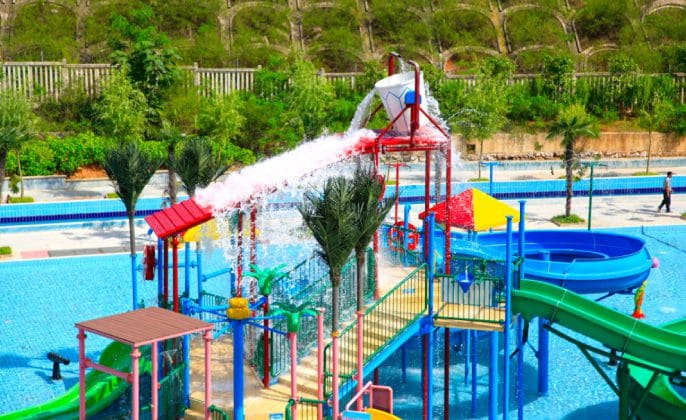
Start with the Children and the Site
A splash pad often serves several age groups at once, and their needs are not identical. Toddlers benefit from shallow, gentle features with clear boundaries and close caregiver access. Older children usually want more variety, changing spray patterns, and space to move between features. A design that mixes these groups without separating their activity zones can create crowding, collisions, and supervision problems.
Site conditions matter just as much. The equipment area, entry gate, shade, seating, changing rooms, plant room, and drainage routes should be planned together. Check wind exposure, sunlight, noise, and access for maintenance vehicles. A feature that looks attractive on a catalogue page may be difficult to service or may spray water into an unsuitable area.
Equipment That Makes Up the Splash Pad
| System | Planning focus | Questions for the supplier |
|---|---|---|
| Water-play features | Age suitability, spray pattern, spacing, and replacement access | How are nozzles reached for cleaning and repair? |
| Surfacing | Slip resistance, drainage, comfort, and color | Which surface is compatible with the treatment and climate? |
| Water treatment | Filtration, disinfection, testing, and controls | What daily records and operator training are required? |
| Pumps and controls | Flow, cycles, fault protection, and energy management | Can individual zones operate independently? |
| Shade and furniture | Supervision, rest areas, and visibility | Do structures obstruct maintenance or emergency access? |
| Fencing and signage | Entry control, capacity, rules, and accessibility | What local requirements apply to the completed area? |
The equipment list should be treated as one connected system. Saving money on drainage or controls can create expensive operating problems later. Likewise, a larger feature package is not automatically better if the treatment system, staffing plan, and site cannot support it efficiently.
Understanding the Splash Pad Cost
The average cost to build a water park depends on several groups of work, not just the visible play products. A complete budget normally needs to cover design, equipment, shipping, site preparation, utility connections, surfacing, drainage, water treatment, shade, fencing, signage, storage, installation, commissioning, testing, and staff training. Local site conditions can change the scope substantially.
- Design and engineering, including the site layout and hydraulic plan
- Water-play features, pumps, filters, controls, and treatment equipment
- Groundworks, drainage, water storage, and utility connections
- Safe play surfacing, shade, fences, gates, seating, and signage
- Delivery, installation, commissioning, spare parts, and training
- Permits, inspections, operating supplies, and contingency
Comparable quotations should use the same scope and clearly identify exclusions. A low equipment price is not useful if the buyer later discovers that installation, filtration, or commissioning sits outside the offer. Ask for a line-item breakdown and a definition of responsibilities at the site boundary.
Planning a budget without unsupported assumptions
Use current local quotations for groundworks and utilities, while asking the attraction supplier for a written equipment scope. Keep design, delivery, installation, and operation as separate budget lines. Add contingency for site surprises and for changes made after approval. Do not compare an early concept price with a full turnkey quotation as if they represent the same project.
Lay Out the Guest Experience
Good circulation starts before a child enters the water area. Families need a clear approach, somewhere to remove shoes, storage for personal items, visible seating, and an exit that does not cross the busiest play zone. Staff need unobstructed views from the control position and a direct route to isolation valves and the plant area.
- Define separate activity zones for younger and older children.
- Keep trip hazards and fixed equipment outside main walking routes.
- Place shade and seating where caregivers can watch the whole pad.
- Provide maintenance access without opening a route through the play area.
- Coordinate signs, capacity limits, and emergency procedures with the layout.
Splash pads created by experienced water parks built by Dinis usually begin with these operating questions rather than a fixed catalogue layout. A custom plan may reduce wasted space, but it should not add complexity that the operator cannot maintain.
Materials, Water, and Daily Maintenance
Materials should suit outdoor exposure, cleaning chemicals, and the local climate. Non-slip surfaces, corrosion-resistant fasteners, accessible nozzles, and replaceable components all matter. Polypropylene can be useful where molded parts need impact resistance and water exposure tolerance, but the complete assembly still needs a maintenance plan from the manufacturer.
The water-treatment routine must be practical for the staff who will operate the attraction every day. Confirm testing frequency, chemical storage, filtration maintenance, backwashing, record keeping, and shutdown procedures. Ask who can service the controls and how quickly common spare parts can be supplied.

Questions to Ask Before Approving the Design
- Which age groups will use each zone, and how will they be separated?
- What is included in the offer, and what remains the buyer’s responsibility?
- How will water be filtered, treated, tested, and recorded?
- Can the operator isolate one feature without shutting down the whole pad?
- How will drainage perform during heavy rain or peak use?
- What spare parts, manuals, and training are supplied?
A children’s splash pad is a good investment when the equipment, site, operating team, and guest experience support one another. Start with the users and the daily routine, then build a complete cost model. To open the full product listing, compare feature groups and required systems. As a theme park ride manufacturer, the project team can help develop a layout that is practical to install and maintain.