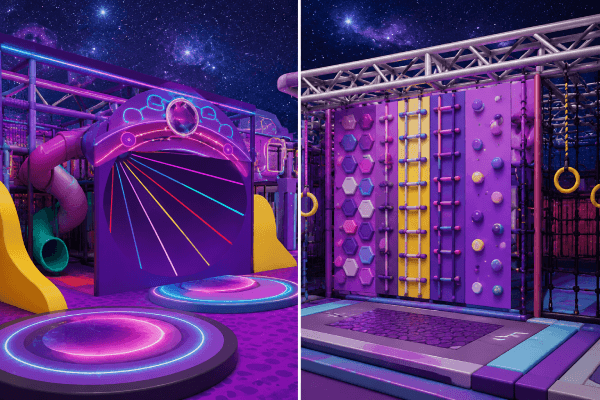
What Belongs in a Ninja Course Equipment Package
Buying a ninja course is closer to equipping a small factory than to picking out a ride. A ninja course equipment buying guide helps operators think in terms of structures, tolerances and delivery schedules instead of colours and themes. Start by writing down the floor area you can actually release, the ceiling height, the age bands you admit and the busy-hour throughput you need. Those four numbers decide which obstacle families are even possible. Operators who begin with the equipment list usually end up redesigning the room; operators who begin with the room end up with a course that fits the building and the staffing plan on day one.
Why the Steel Frame Decides Long-Term Cost
The frame carries every load in the venue, so it deserves the most scrutiny. A commercial ninja course steel frame package should specify tube wall thickness, coating system, anchor spacing and the way modules join, because those details decide how often the structure needs to be re-tensioned or re-painted. Ask for deflection figures under a worst-case load rather than a photograph of an installed venue. Powder coating over properly prepared steel survives humidity far better than a paint finish applied on site, and welded joints that are jig-built at the factory behave more predictably than brackets assembled in a warehouse.
Choosing Obstacles by Difficulty and Throughput
Obstacle choice should follow the difficulty curve, not the catalogue order. Buildings with generous height often pair the ninja run with a commercial high ropes course, because the two attractions share a demand for safe rigging while appealing to different appetites for height. Balance elements, grip elements and climbing elements each reset the body differently, so alternating them keeps a run interesting without exhausting younger guests. For every element, record the space it occupies, the release height, the landing surface beneath it and the number of guests it can hold at once; that table becomes the specification you send to suppliers.
Lead Time: What Actually Drives the Schedule
Lead time is rarely one number. Steel fabrication, coating, obstacle manufacturing, packing, ocean freight, customs clearance and inland delivery all have their own queues, and the long pole is usually whichever step starts last rather than whichever takes longest. Public references on procurement describe how buyers stage orders and hold suppliers to milestones, and the same discipline works here: fix the drawing, release the frame first, and let obstacles follow in the sequence they will be installed. Locking a delivery window against a written schedule is worth more than a verbal promise.
Quality Checks Before You Sign the Order
Before signing, walk the quality checklist rather than the showroom. Confirm the steel grade, the coating thickness, the fall-surface specification and the certification documents you will actually receive, and ask who holds spare parts. Working with a Miland indoor playground manufacturer keeps the frame, the obstacles and the soft flooring under one warranty, which removes the argument about whose component failed when an element wears out. A single supplier also means one drawing set and one installation sequence instead of two contractors waiting for each other.
Planning Installation and Spare Parts
Finally, plan the boring parts: installation access, the hours the site can be worked, spare slings and padding covers, an inspection log and a route for changing one obstacle without closing the whole attraction. Budget for the consumables that wear, not only for the steel that does not. Categories: Indoor Playground, Ninja Course, Obstacle Course, Family Entertainment Center, Commercial Playground Equipment, Procurement. Tags: ninja course equipment, steel frame, obstacle course, lead time, family entertainment center, commercial playground equipment. https://www.milandplay.com/product/ninja-course/