Owners comparing water park proposals quickly discover that quotations are rarely presented the same way. One supplier quotes a lump sum, another quotes per attraction, and a third quotes per square metre. The per-square-metre figure is the most useful of the three because it lets you test a design against a budget before a single drawing is issued – provided you know what it includes. This guide explains how to read it, and how to sanity-check the water park construction cost you are quoted.
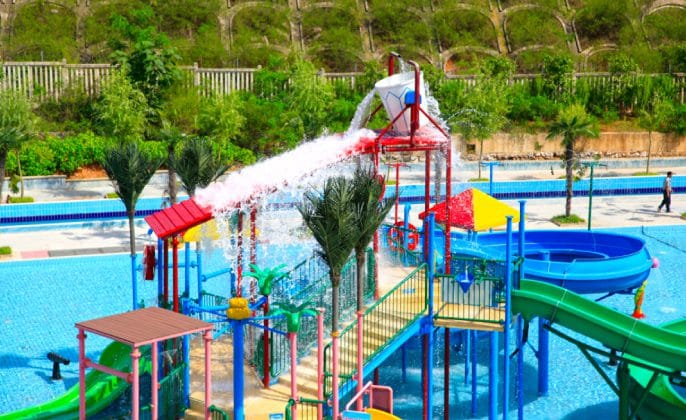
Owners often approach us with one figure in mind: the cost per square meter of a water park. That number is only meaningful once you have agreed what the square metres include.
What a Cost per Square Metre Figure Should Include
A credible number covers the whole developed area, not just the pools. Ask any supplier to state whether their rate includes:
- Earthworks, retaining structures and drainage
- Pool shells, waterproofing and tiling
- Water park attractions: slides, splash structures, play units
- Filtration, disinfection, pumps, pipework and the plant room
- Changing rooms, entrance building, shade structures and paving
- Lighting, electrical distribution and life safety systems
- Freight, duties, installation and commissioning
Rates quoted without installation and water treatment are the most common cause of budget overruns, because those two blocks alone can add 20 to 30 percent to the headline figure. If you need the full breakdown of what a project costs, see how much does it cost to build a water park before you shortlist suppliers.
Indicative Cost per Square Metre by Park Type
The table below is a planning benchmark for the developed water park area, including attractions and the plant room, but excluding land purchase. Figures are indicative and depend on local labour, freight and the standard of finish.
| Park type | Developed area | Indicative cost per m² (USD) | Typical attraction mix |
|---|---|---|---|
| Hotel or resort splash area | 300 – 1,500 m² | 450 – 900 | Splash pad, one or two body slides |
| Community water park | 1,500 – 5,000 m² | 350 – 700 | Leisure pool, 3 – 4 slides, kids zone |
| Commercial water park | 5,000 – 20,000 m² | 280 – 550 | Racer slides, raft slide, wave pool, F&B |
| Destination water park | 20,000 m² + | 250 – 500 | Themed structures, multiple pools, cabanas |
Two effects explain why the rate falls as the park grows. Fixed costs – design, plant room, entrance building, ticket systems – are spread over more square metres, and large slides carry more guests per square metre than a splash pad. Small projects therefore always show a higher rate, which is normal rather than a sign of a bad quotation.
What Pushes the Figure Up or Down
Attraction mix
A splash pad costs a fraction of a wave pool per square metre. If your scheme is heavy on wave pools, raft slides and themed structures, expect the upper end of the range.
Site conditions and earthworks
Flat, well-drained land is the cheapest to develop. Sloped sites need retaining walls; soft ground needs piling; rocky ground needs excavation by machine rather than by hand. A site investigation carried out before design usually pays for itself.
Water treatment and the plant room
Turnover rates set by local health codes dictate pump size, pipe diameter and the volume of the plant room. Slides and pool shells are commonly built from FRP, whose resin grade and surface finish also affect both price and service life.
Buildings, theming and finishes
Theming is the most controllable line in the budget. Rockwork, theming and imported finishes can double the cost of an entrance plaza; local stone, planting and standard shade structures deliver most of the guest experience for far less.
Freight, duties and local labour
Sea freight, import duty and installation labour vary enormously by country and should always be quoted separately. Comparing two suppliers on ex-works price alone is meaningless.
How to Use a Per-Square-Metre Rate in Budgeting
- Fix the developed area first, then multiply by a mid-range rate to get an order-of-magnitude budget.
- Split the total into attractions, water treatment, buildings and site works, and check each block against the percentages in the cost guide.
- Add 10 percent contingency and a separate freight and duty line.
- Phase the build so the splash pad and two slides open first, then reinvest season-one revenue.
It also helps to talk to an experienced water park equipment manufacturer before the layout is frozen: a small change to the pool geometry or the position of the plant room can move the per-square-metre figure more than any negotiation on price.
Frequently Asked Questions
Does the cost per square metre include the water park equipment?
It should. If a supplier quotes a rate for civil works only, add the attraction package and the plant room before comparing it with a turnkey proposal.
Why is the rate higher for a small water park?
Fixed costs such as design, the plant room and the entrance building are spread over fewer square metres, and small attractions carry fewer guests per square metre.
How accurate is a per-square-metre benchmark?
Treat it as a planning tool accurate to roughly plus or minus 20 percent. It is reliable enough to test whether a concept fits a budget, not to replace a detailed quotation.
Comparing a Concept Against a Budget
Send us the site area, the target opening date and the attraction mix you have in mind, and we will return a block-by-block estimate based on complete water park solutions from Dinis, from attraction selection through to commissioning. If you would rather read the full cost breakdown first, read more here before you approach suppliers.