Water park budgets are usually discussed as a single number, but the industry works in four size bands, and each one has a different cost structure. A small park is dominated by fixed costs; a large park is dominated by water volume, plant capacity and staffing. Comparing them without accounting for that difference is how feasibility studies go wrong.
This comparison uses the size bands published in our guide to the water park cost to build and explains what actually changes between them.
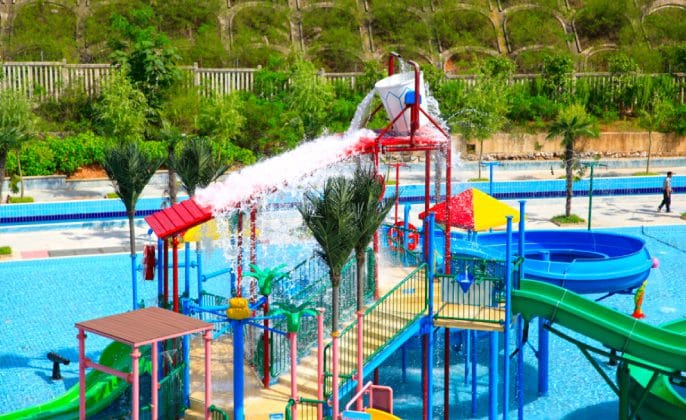
The Four Size Bands
| Band | Area | Published investment range | Typical attractions |
|---|---|---|---|
| Small | 500 – 2,000 m² | USD 1M – 2M | Splash pad, 2 – 3 slides, leisure pool |
| Medium | 2,000 – 10,000 m² | USD 4M – 6M | Racer or raft slides, kids zone, F&B |
| Large | 10,000 – 50,000 m² | USD 10M – 12M | Wave pool, multiple towers, lazy river |
| Mega | 50,000 m² + | USD 100M + | Destination mix, themed structures |
Two things stand out. First, cost per square metre falls as the park grows, because fixed costs spread over more area. Second, the absolute jump between bands is large – a medium park is not simply a bigger small park.
Small Water Park: Fixed Costs Dominate
At 500 to 2,000 m² the design fee, the plant room, the entrance building and the ticket system are largely fixed. They weigh heavily on the total, which is why the cost per square metre is highest in this band. The attractions are modest: a splash pad, two or three slides and a leisure pool.
The advantage is speed and risk. A small park can open within a season, and a realistic water park construction cost estimate can be assembled before design starts. The disadvantage is capacity: on a busy weekend the queue becomes the constraint long before the site does.
Medium Water Park: The Volume Business
Between 2,000 and 10,000 m² the park starts to behave like a business. Multiple slides, a dedicated children’s zone and proper food and beverage become viable, and the visitor catchment widens beyond the immediate neighbourhood. The plant room grows substantially because water volume and turnover requirements rise with every pool added.
This is the band where the water park project budget most often needs phasing. Opening with the splash zone and two slides, then adding the wave pool from season-one revenue, keeps the opening capital manageable without giving up the final vision.
Large Water Park: Engineering-Led
Above 10,000 m² the project becomes engineering-led. Structural design, water treatment capacity, pumping, drainage, staff circulation and emergency planning all need specialist input. The published range of USD 10M to 12M reflects a park with a wave pool and multiple slide towers, not a destination-scale resort.
At this size, small specification decisions have large consequences. A pump selected for phase one and expanded later can add cost that no procurement negotiation recovers. Steel and fixings are usually protected with Hot-dip galvanization or equivalent, and that specification should be agreed before the structural drawings are frozen.
What Actually Changes Between Bands
- Water treatment. Turnover rates apply per pool; a large park may run several independent treatment loops.
- Staffing. Lifeguard numbers scale with water bodies, not guests.
- Access and parking. A successful medium park can require more parking than the original site plan allowed.
- Energy. Filtration and heating run daily regardless of attendance.
- Maintenance. More rides mean more spares, more training and a larger workshop.
How to Choose the Right Band
Work backwards from the visitor target. Estimate peak-day attendance, then divide by a realistic per-guest water area to get the minimum size. If the resulting band is above your capital, phase within the band rather than dropping to a smaller one – a park that is too small cannot recover its fixed costs on busy days.
For the full cost breakdown behind each band, visit this page. It explains which lines are fixed and which scale, so the comparison is like for like.
Comparing the Three Bands Financially
Put the bands on the same financial basis before choosing. Compare capital cost per peak-day guest, not cost per square metre: divide each band total by the attendance it can serve comfortably, and the smaller parks will look expensive while the larger ones look efficient. Then compare operating cost per guest, which moves the other way because larger parks carry more lifeguards, more pumps and more maintenance.
The decision usually sits between those two figures. A park that is too small carries high fixed cost per guest; a park that is too large carries high operating cost before demand arrives. The right band is the smallest one that keeps peak queues acceptable and covers fixed costs at a conservative attendance figure.
Frequently Asked Questions
Is a small water park profitable?
Yes, if it is attached to an existing attraction or hotel that already supplies visitors. Standalone small parks depend heavily on local repeat business.
When does a wave pool make sense?
Usually above roughly 4,000 m² of water park area, where the visitor base can justify the plant and staffing load.
Can a medium park be built in phases?
Yes, and it is the most common approach. Phase one opens the core attractions; later phases add capacity once demand is proven.
Next Step
Send us your site area and target attendance, and we will recommend a size band and a phased plan. Our Dinis amusement park solutions team can quote the attractions and plant room together, and as a commercial water park equipment supplier we can advise on the civil interface so the budget matches the band you choose.