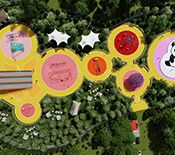
Layout drawings look like a design exercise and behave like a cost document. The position of a path, the direction a service road runs and the space left between two rides all determine how much earth has to be moved, how much pipe has to be laid and how easily the park can grow later. None of those consequences appear on the layout sheet itself.
This article explains how layout geometry changes construction cost, and how to draw a plan that leaves room for expansion without paying for it twice. It complements a how much does it cost to build an amusement park budget, where the layout is what turns a ride list into site works.
Earthworks Follow the Layout, Not the Ride
A layout that places rides on the natural levels of the site requires far less cut and fill than one that imposes a single flat platform across sloping ground. The difference is not a detail: earthworks, retaining structures and drainage can consume a large share of the civil budget.
The cheapest plan is usually the one that keeps the main circulation route on the natural grade and places the rides that need level ground on the flattest part of the site.
Paths Are Expensive Because They Carry Services
Every path is also a trench. Lighting, power, water and data all follow the circulation network, and a path that wanders adds length to every one of those services.
A compact, legible path network with a clear spine reduces both the paving area and the length of cable and pipe. It also makes the park easier to navigate, which is why the cost-efficient layout is often the better visitor experience as well.
Group Rides by Shared Infrastructure
Rides that share a power distribution point, a drainage connection and a service access route are cheaper to build than the same rides spread across the site. Grouping also reduces the number of foundations that have to be designed and inspected separately.
This does not mean placing every family ride in one corner. It means letting the infrastructure plan inform the grouping, so that the rides with similar utility needs sit together.
Keep Service Routes Separate
Deliveries, maintenance vehicles and emergency access need a route that does not cross the visitor flow. On a compact site that route is often the hardest thing to find, and a layout that ignores it will pay for the omission in operating friction for the life of the park.
Drawing the service route first, before the ride positions, usually produces a better plan than adding it afterwards.
Reserve Expansion Space in the Right Place
Future expansion is cheaper when the reserved land already has the utilities and access it will need. A spare plot at the back of the site with no power and no road is worth much less than a smaller plot beside the existing infrastructure.
The plan should show where the next ride will go, how it will be served and how visitors will reach it. That is the difference between a park master plan for expansion and a drawing that simply leaves an empty area.
Design the Drainage Before the Landscaping
Surface water has to leave the site somewhere, and the route it takes is determined by levels. Layouts that are drawn without a drainage strategy usually end up with water pooling in the lowest ride area, which is both a construction cost and an operating problem.
Setting the drainage strategy early also fixes the finished levels of the paths and plazas, which in turn constrains the ride foundations.
How the Layout Affects the Ride Order
A well-designed layout can reduce the ride budget as well, because it allows standard models to fit instead of forcing custom structures into awkward spaces. It also lets the park open in phases without temporary works that later have to be removed.
Buyers who want an amusement park design and layout review can ask the ride supplier for the foundation and clearance data before the master plan is finalised, so the two documents are developed together. An amusement park layout planning from Dinis package normally starts from the site levels and the service routes rather than from a ride list.
Layout Is a Long-Term Decision
Rides can be replaced; a layout cannot. The path network, the service routes and the utility corridors will outlast several generations of equipment, and every later phase will be constrained by them.
That is why it is worth spending design time on the plan before construction starts. Structural components such as steel frames can be specified later, but the ground they stand on cannot be rearranged cheaply.
Dinis supplies rides and park equipment and works as an amusement park rides manufacturer, providing foundation and clearance data that lets the layout and the ride list be developed together. Reference: https://www.kidsparksolutions.com/how-much-does-it-cost-to-build-an-amusement-park/